Every business that operates across language boundaries eventually faces the translation investment decision: how much to spend, when professional translation is justified versus acceptable alternatives, and how to measure the return on that investment. Most businesses make these decisions ad hoc, based on gut feel or immediate budget pressure rather than systematic analysis. The result is often a pattern of underinvesting in translation for high-stakes content (where errors are costly) and overinvesting in translation for low-stakes content (where faster, cheaper options would suffice). This guide provides a framework for making translation investment decisions rationally.
Why Translation Quality Matters for Business Outcomes
The direct cost of poor translation is often visible: a mistranslated contract clause that creates legal liability, a product manual that causes a safety incident, a marketing campaign that offends rather than attracts. The indirect costs are less visible but equally real: customer trust eroded by poorly localized content, conversion rates suppressed by website copy that doesn’t resonate, and competitive disadvantage in markets where local competitors communicate fluently.
The Translation Quality-Revenue Link
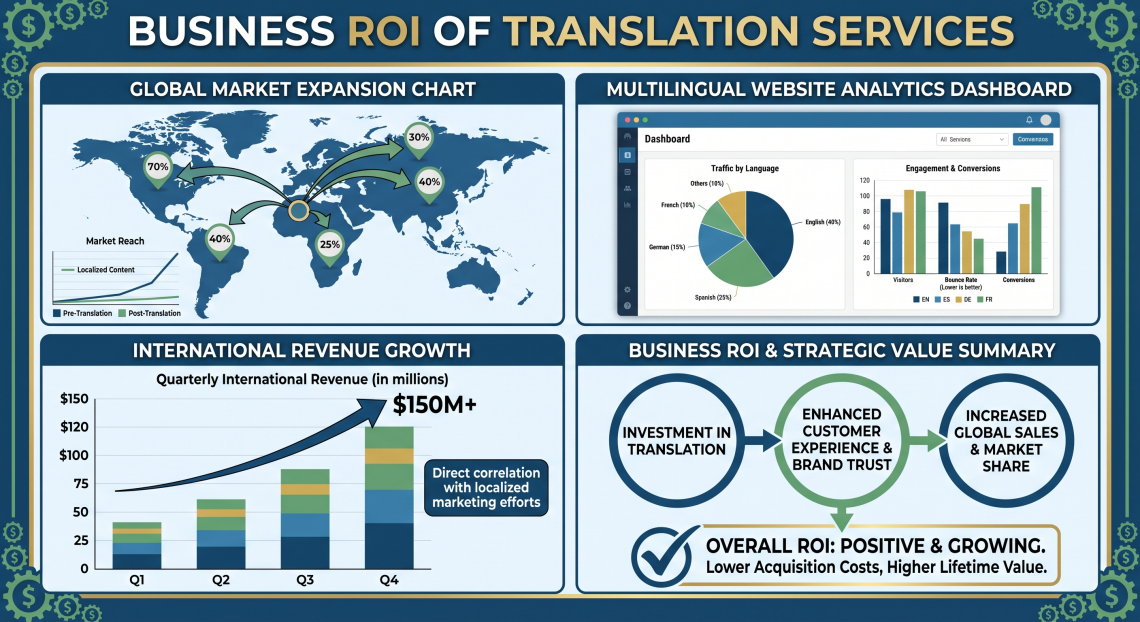
Research consistently finds that language quality significantly affects purchase behavior across international markets. A 2020 survey by CSA Research found that 75% of consumers prefer to buy products in their native language, and 40% will not buy in other languages at all. For e-commerce businesses, localized websites typically convert 70% better than translated-only sites, and localized marketing content generates 3–4x higher engagement than unlocalized campaigns. These are not marginal differences — they’re large enough to determine market viability in many international segments.
The Cost of Translation Failures
| Failure Type | Examples | Potential Cost |
|---|---|---|
| Legal/compliance | Mistranslated contracts, incorrect regulatory filings | $10K–$10M+ |
| Product safety | Incorrect instructions, warning label errors | Liability + brand damage |
| Marketing embarrassment | Culturally inappropriate campaigns | Brand damage, campaign waste |
| Customer service | Miscommunication leading to churn | Customer lifetime value |
| Conversion rate | Poor website localization | Revenue opportunity cost |
Building a Translation Investment Framework
A rational translation investment framework starts with classifying content by risk and revenue impact — the two factors that should drive quality and investment level decisions.
The Content Classification Matrix
Classify your translation needs on two dimensions: stakes (the potential cost of an error) and volume (the amount of content to translate). High-stakes, low-volume content (legal documents, regulatory filings, critical product documentation) should receive premium professional translation with expert review. High-stakes, high-volume content (customer-facing website copy, product descriptions) should use professional translation with a scalable workflow, potentially incorporating MT post-editing. Low-stakes content (internal communications, rough drafts, initial research) can use MT or lower-cost services.
Calculating Translation ROI
For customer-facing content, translation ROI can be estimated using market size and conversion rate data. If a new language market represents 500,000 potential customers, your product’s average order value is $100, and professional translation improves conversion rate from 1% to 1.7%, the incremental revenue attributable to translation quality is $350,000 — the translation investment cost should be evaluated against this figure. This framework makes the business case tangible rather than abstract.
When to Use Professional Human Translation
Professional human translation is the appropriate choice when quality, precision, and cultural resonance are business-critical. The decision criteria are not simply “high value” — they’re about the specific consequences of quality shortfalls.
Non-Negotiable Cases for Human Translation
Legal and compliance documents — contracts, regulatory submissions, patent applications — should always use qualified human translators. Customer-facing brand content where voice and cultural resonance matter — website copy, marketing campaigns, product descriptions — should use professional translation, ideally with native-speaker review. Any content submitted to regulatory bodies, courts, or official proceedings typically requires certified human translation.
The MT Post-Editing Middle Ground
Machine translation with human post-editing (MTPE) is the most cost-effective approach for moderate-stakes, high-volume content. MT handles the structural translation; a professional human translator corrects errors and improves naturalness. MTPE typically costs 40–60% less than full human translation and is appropriate for technical documentation, e-commerce product descriptions, and customer support content where quality matters but marginal differences from premium translation don’t justify the cost differential.
Building Translation into Business Processes
Ad-hoc translation purchasing — requesting translations project by project from different vendors — is the most expensive and lowest-quality approach. Organizations that localize at scale build systematic processes that reduce cost and improve consistency.
Translation Memory: The Efficiency Multiplier
Translation memory (TM) is a database of previously translated content segments that can be automatically applied when the same or similar text appears in new content. Over time, TM accumulates to the point where significant portions of new documents can be populated automatically, dramatically reducing both translation cost and turnaround time. Organizations with active translation programs typically see TM savings of 20–40% within 12–18 months. Requiring your translation vendor to use TM and provide TM files (in TMX format) that you own is essential for long-term cost management.
Terminology Management
Consistent use of key terms — product names, technical terminology, brand language — across all translated content requires active terminology management. A corporate glossary that specifies approved translations for key terms, distributed to all translators working on your content, prevents the inconsistency that makes content feel unnatural or unprofessional in target markets. Most translation management systems support glossary integration.
Centralized Translation Management
Organizations that manage multiple language pairs and content types benefit significantly from centralized translation management through a Translation Management System (TMS). Tools like Phrase, memoQ, SDL Trados, or Smartling provide workflow management, TM and glossary integration, quality tracking, and vendor management in a unified platform. For businesses spending more than $50,000 per year on translation, TMS investment typically pays for itself through efficiency gains within 12 months.
Selecting and Managing Translation Vendors
The translation vendor landscape ranges from large multinational agencies to specialized boutiques to freelancer marketplaces. Matching vendor type to content needs significantly impacts quality and cost.
Vendor Selection Criteria
For high-stakes content (legal, regulatory, brand-critical marketing), prioritize vendors with demonstrable subject-matter expertise in your field, native-speaker reviewers in target markets, ISO 17100 certification (the international quality standard for translation services), and references from similar clients. For standard commercial content, evaluate pricing, turnaround, TM compatibility, and responsiveness alongside quality credentials. Never select a vendor solely on price — the cost of poor translation in customer-facing or legal contexts always exceeds the savings from the lowest bidder.
Frequently Asked Questions
What’s the biggest waste in corporate translation budgets?
The most common waste is applying premium professional translation to internal content that would be adequately served by MT or low-cost services, while simultaneously cutting corners on customer-facing or legal content where quality directly affects revenue and risk. The fix is content classification — systematically matching quality level to stakes, not applying a uniform standard to all translation needs.
How do I compare translation quality across vendors?
Request sample translations of content similar to your actual needs from shortlisted vendors. Have the samples reviewed by native speakers in your target market (employees, customers, or professional reviewers). Evaluate for accuracy, naturalness, terminology consistency, and cultural appropriateness. Never evaluate translation quality by asking the vendor to review their own work — independent review is essential.
Should I build an in-house translation team?
In-house translation makes sense for organizations with very high, consistent translation volumes (typically $500K+ per year) in a limited number of language pairs. For most businesses, a hybrid model — in-house translation coordinators managing quality and vendors, with translation work performed by specialized external providers — offers better economics and access to specialized expertise than a fully in-house team.
How should I think about AI translation tools for business?
AI translation tools (DeepL, Google Translate, modern MT systems) have improved dramatically and are appropriate for a growing range of use cases. They’re genuinely useful for internal communication, initial drafts, and content screening. They remain inadequate for legal documents, brand-critical marketing, and any content where cultural nuance or precise technical accuracy is required. Treat AI translation as a productivity tool for your translators and a quick-understanding tool for your team — not as a replacement for professional translation in high-stakes contexts.
Conclusion
Professional translation is a business investment that should be evaluated like any other: based on the return it generates relative to the cost and the risk it mitigates relative to alternatives. Building a systematic framework — classifying content by stakes and volume, calculating revenue impact of quality differences, implementing translation memory and terminology management, and matching vendor quality level to content requirements — transforms translation from a reactive cost center into a strategic capability that directly supports revenue growth and risk management in global markets.