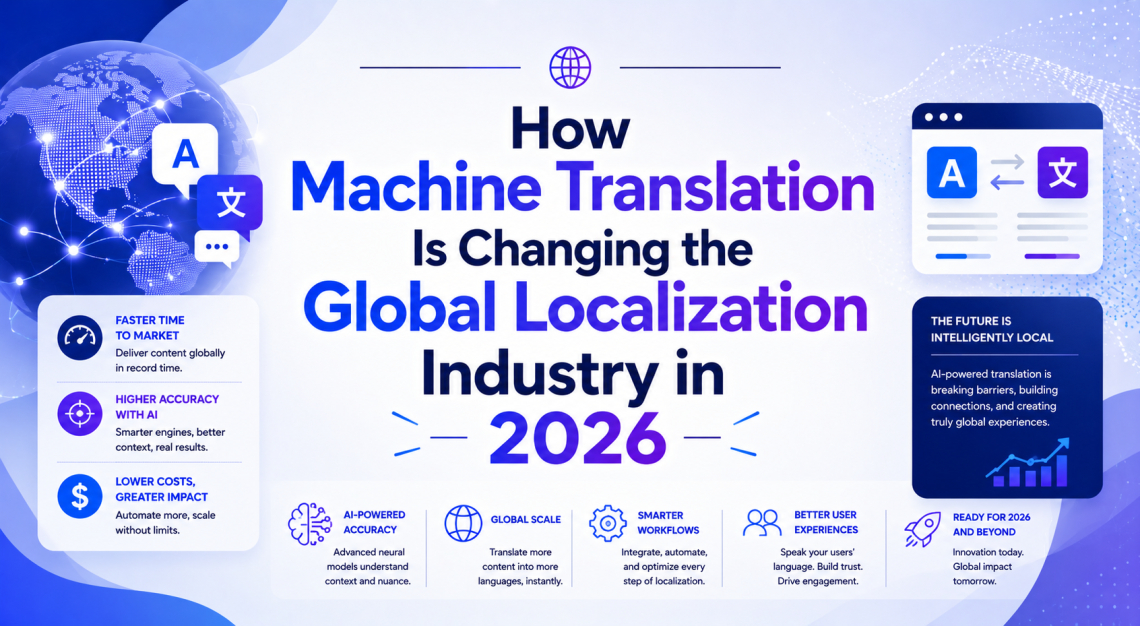
The localization industry is undergoing its most significant structural transformation since the introduction of computer-assisted translation tools in the 1990s. Machine translation powered by large language models has shifted from a tool that required extensive post-editing to one that produces near-publication-quality output for many content types in many language pairs — and the industry is still working out what this means for workflows, pricing, quality standards, and the role of human linguists. Understanding these shifts is essential for anyone buying or selling localization services in 2026.
The State of Machine Translation Quality in 2026
Modern neural machine translation (NMT) systems, particularly those built on large language model architectures, have achieved quality levels that were considered impossible five years ago for well-resourced language pairs. The gap between human and machine translation quality has narrowed dramatically, but it has not disappeared — and the remaining gap is concentrated in predictable places.
Where Machine Translation Excels
For content with regular structure, technical terminology, and factual information — software UI strings, technical documentation, product descriptions, and standard business correspondence — MT quality in high-resource language pairs (English-Spanish, English-French, English-German, English-Japanese) is now regularly good enough for publication with minimal or no human review. Studies in 2025 found that professional translators evaluating blind samples could not reliably distinguish between high-quality MT output and human translation for these content types.
Where Human Translators Still Lead
Marketing copy, brand voice, cultural adaptation, humor, literary content, and highly contextual creative writing still require human judgment that current MT systems cannot reliably provide. These domains require not just linguistic accuracy but cultural intelligence, creative decision-making, and brand sensitivity that LLMs handle inconsistently. Additionally, low-resource language pairs (language combinations with limited training data) continue to produce MT output requiring substantial human correction.
The MTPE (Machine Translation Post-Editing) Workflow
Machine Translation Post-Editing has become the dominant workflow in the localization industry, replacing full human translation for most high-volume content. Understanding how this workflow functions and what quality levels it produces is essential for localization buyers.
Full Post-Editing vs. Light Post-Editing
Full post-editing (MTPE-FPE) produces output equivalent in quality to direct human translation — every segment is reviewed and corrected to publication quality by a professional linguist. Light post-editing (MTPE-LPE) focuses only on accuracy errors (mistranslations, omissions, additions) without addressing style, fluency, or localization consistency. The appropriate level depends on content purpose and audience.
Human Translator Productivity in MTPE
Professional translators working with high-quality MT output can post-edit 4,000-8,000 words per day compared to 1,500-2,500 words per day for direct human translation. This productivity increase has driven MT adoption throughout the industry, though it has also compressed rates — translators paid per word earn significantly less per hour when post-editing highly accurate MT output compared to translating from scratch.
Machine Translation Quality by Content Type
| Content Type | MT Raw Quality (EN-ES) | MTPE Required | Cost vs. Human Translation | Recommended Workflow |
|---|---|---|---|---|
| Technical documentation | Excellent | Light | 40-60% less | MTPE-LPE |
| Software UI/UX strings | Very Good | Light-None | 50-70% less | MT + automated QA |
| Marketing copy | Good | Full | 20-30% less | MTPE-FPE or transcreation |
| Legal documents | Moderate | Full + specialist review | 10-20% less | Human translation primary |
| Literary/creative | Fair | Extensive | Minimal savings | Human translation only |
How Global Brands Are Restructuring Localization Programs
Enterprise localization programs have been restructured significantly in response to MT capabilities. The strategic question has shifted from “how do we translate efficiently?” to “which content warrants which quality level?”
Content Tiering Strategies
Leading enterprise localization programs segment content into tiers based on business impact and audience sensitivity. Tier 1 content (marketing campaigns, executive communications, brand-defining assets) receives full human translation with transcreation review. Tier 2 content (support documentation, product descriptions, standard correspondence) uses MTPE-FPE. Tier 3 content (internal communications, historical archives, low-traffic web pages) uses raw MT or MTPE-LPE with minimal human review.
Translation Memory and Terminology Management
The most sophisticated enterprise programs maintain large translation memories and terminology databases that are used to customize MT output to the brand’s linguistic standards before post-editing. Custom MT engines fine-tuned on a brand’s translation memory produce substantially better output for that brand’s specific content than generic MT engines, reducing post-editing effort significantly.
The Evolving Role of Human Translators
The localization industry’s shift to MT-centric workflows has created significant disruption for translators, but the transition has been more nuanced than early predictions of displacement suggested.
From Translators to Language Specialists
The human translator’s role has evolved toward higher-value activities: transcreation (creative adaptation rather than translation), terminology management, MT quality evaluation, cultural consultation, and specialized domain translation (legal, medical, patent) where MT quality remains insufficient. Translators who have adapted to these roles report higher per-hour earnings despite lower per-word rates because their work requires expertise that commands premium pricing.
Frequently Asked Questions
Will machine translation replace human translators entirely?
No, and this outcome is not projected even by the most bullish MT advocates. Human translators will continue to be essential for creative content, cultural adaptation, quality assurance, specialized domains (legal, medical, technical), and any content where nuance, brand voice, and cultural intelligence are required. The volume of content requiring translation is growing faster than MT adoption, meaning total demand for human linguistic expertise is increasing even as the per-word share declines.
How do you evaluate machine translation quality?
Automated metrics like BLEU, COMET, and METEOR provide technical quality measurements but correlate imperfectly with human quality perception. Human evaluation by professional translators using MQM (Multidimensional Quality Metrics) provides the most reliable quality assessment. For production decisions, testing MT quality on a representative sample of your specific content type with your specific language pairs is the most reliable evaluation method.
Is MT suitable for regulated industries?
With appropriate human review, yes for some applications. The EU and FDA have both issued guidance on the use of machine translation in regulated contexts, generally requiring post-editing and human review by qualified translators for any document with regulatory significance. Raw MT output is not acceptable for pharmaceutical labeling, medical device documentation, or financial regulatory filings in most jurisdictions.
Conclusion
Machine translation in 2026 is not replacing the localization industry — it is restructuring it. The most effective localization programs are those that have developed sophisticated content tiering strategies, invested in translation memory and terminology infrastructure to maximize MT quality, and positioned their human linguists on the high-value work that MT cannot do well. For buyers of localization services, understanding this landscape means you can make smarter decisions about where to invest in quality and where to leverage automation, rather than treating all translation as equivalent commodity work.