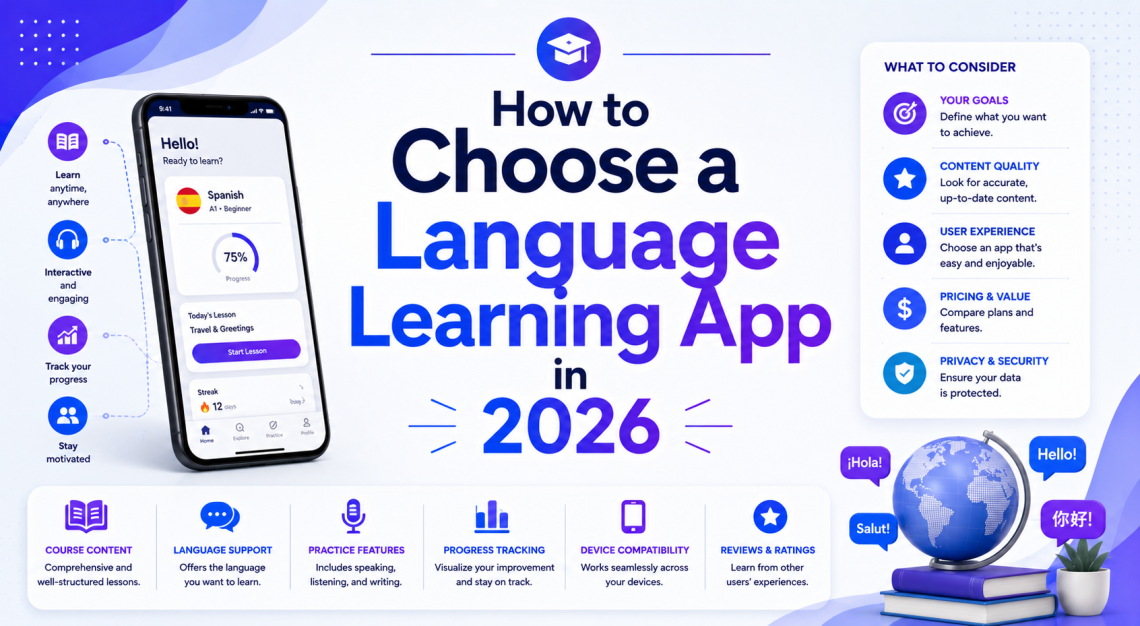
Language learning apps have become the most popular entry point for learning a new language in 2026, with hundreds of millions of learners using digital tools as their primary or supplementary learning method. The category has matured significantly — the best apps now incorporate AI conversation partners, pronunciation feedback, adaptive curriculum engines, and integrated cultural context that was unavailable just three years ago. But the proliferation of options has also made the choice more complex. The right app depends heavily on your learning goals, target language, learning style, and how you define success.
How to Define Your Language Learning Goals Before Choosing an App
The most common mistake language learners make is choosing an app before defining what success looks like. Language learning encompasses reading, writing, listening, and speaking — and most apps are significantly stronger in some of these than others. Knowing your goal narrows the field dramatically.
Conversational Fluency vs. Academic Proficiency
If your goal is conversational fluency for travel, business relationships, or living abroad, you need an app that prioritizes speaking practice, real-world vocabulary, and listening comprehension. If your goal is academic proficiency, professional certification (DELF, JLPT, HSK), or literary reading, you need an app that emphasizes grammar depth, writing skills, and formal register. Most apps optimize for one of these goals more than the other.
Beginner vs. Intermediate vs. Advanced Learner Needs
Apps vary significantly in how well they serve learners at different proficiency levels. Some (Duolingo, Babbel) are designed primarily for beginners and struggle to keep intermediate learners engaged and progressing. Others (Lingodeer, Clozemaster) are more effective for intermediate-to-advanced learners who need structured grammar review and vocabulary expansion beyond beginner conversational patterns.
The Top Language Learning Apps in 2026: What They Actually Do Well
Rather than ranking apps overall, understanding each platform’s genuine strengths and limitations helps you select the right tool for your specific situation.
Duolingo
Duolingo remains the world’s most-downloaded language learning app in 2026, with over 700 million registered users. Its gamification, streak system, and accessibility make it the best app for habit formation and maintaining a daily learning practice. Duolingo’s 2026 updates have improved its conversation practice through AI dialogue partners and improved its grammar explanation quality. However, it remains primarily a supplementary tool — completing Duolingo courses produces solid reading and recognition skills but weaker speaking and production abilities without additional practice.
Babbel
Babbel takes a more structured, curriculum-driven approach than Duolingo, with lessons developed by professional linguists and organized around communication-focused themes. Its speech recognition and pronunciation feedback are among the best in the category. Babbel works best for European languages (strong Spanish, French, German, Italian programs) and is better suited to learners who want structured progression with clear grammar explanations rather than gamified practice.
Rosetta Stone
Rosetta Stone’s immersive, image-based approach avoids translation — you learn to associate target language words directly with concepts rather than through your native language. This approach builds intuitive thinking in the target language but is slow by other apps’ standards and frustrating for learners who want grammar explanations. The 2026 version’s TruAccent speech recognition and live tutoring integration are genuine strengths for pronunciation-focused learners.
Pimsleur
Pimsleur uses spaced repetition audio lessons based on research into how the brain retains language. It is primarily an audio program, making it ideal for commuting, driving, or exercise. Pimsleur produces strong speaking and listening skills but minimal reading or writing ability. For learners whose primary goal is spoken conversational fluency and who have commute time to fill, Pimsleur is among the most effective options despite its high price point.
AI-Powered Conversation Apps (Speak, Elsa, Lingvist)
A new category of AI conversation apps has matured significantly in 2026. Speak (English/Korean/Japanese focus) uses AI conversation partners for unlimited speaking practice with real-time feedback. Elsa specializes in English pronunciation using AI accent coaching. Lingvist uses AI-driven spaced repetition vocabulary learning tailored to your learning gaps. These specialized AI tools are most effective as supplements to structured learning rather than primary programs.
Language Learning Apps Compared
| App | Best For | Speaking Focus | Grammar Depth | Price/Month | Best Languages |
|---|---|---|---|---|---|
| Duolingo | Habit building, beginners | Medium | Low-Medium | Free/$7 | Spanish, French, German |
| Babbel | Structured learning, Europeans | High | Medium-High | $15 | European languages |
| Rosetta Stone | Immersive learners | Very High | Low (implicit) | $12 | Major world languages |
| Pimsleur | Audio/spoken fluency | Very High | Medium | $20 | Major world languages |
| Speak (AI) | Conversation practice | Very High | Low | $12 | English, Korean, Japanese |
| Lingodeer | Asian language learners | Medium | High | $10 | Japanese, Korean, Chinese |
Building an Effective Language Learning Stack
The most effective language learners in 2026 do not rely on a single app. They build a complementary stack of tools that addresses different aspects of language acquisition simultaneously.
The Core Stack for Conversational Fluency
A high-effectiveness stack for conversational fluency combines structured curriculum (Babbel or Pimsleur for grammar and vocabulary foundation), spaced repetition vocabulary (Anki or Lingvist for systematic vocabulary expansion), and conversation practice (Speak AI for unlimited low-pressure speaking practice, italki or Preply for scheduled sessions with human tutors). This combination addresses all four language skills while optimizing cost and time efficiency.
The Immersion Supplement
Beyond app-based learning, adding immersive input dramatically accelerates progress at the intermediate level. Comprehensible input through graded readers, native content with subtitles (using Language Reactor for Netflix/YouTube), and passive listening (podcasts, radio in the target language at background volume) builds the large vocabulary and natural grammar intuition that no app can fully develop.
Frequently Asked Questions
Can you become fluent with just a language app?
For most languages and most definitions of fluency, no. Apps build vocabulary, grammar foundations, and reading skills effectively. Conversational fluency requires extensive speaking practice with real speakers and immersive input that apps provide only partially. Apps work best as the structured foundation of a broader learning program.
How long does it take to reach conversational fluency with an app?
For closely related languages (a Spanish speaker learning Portuguese, or a French speaker learning Italian), 200-400 hours of focused study can reach conversational fluency. For more distant languages (English speaker learning Mandarin or Arabic), 1,000-2,000 hours is typical. Apps used alone, even consistently, rarely produce true conversational fluency without real conversation practice.
Is Duolingo actually effective for learning a language?
Yes, for what it is designed to do — which is habit formation and beginner-to-low-intermediate reading and recognition. The 2020 Carnegie Mellon study found that 34 hours of Duolingo Spanish produced outcomes equivalent to a university Spanish semester for reading and listening. For speaking and higher-level proficiency, Duolingo needs to be supplemented with other tools and real conversation practice.
Which language learning app is best for Japanese?
Lingodeer provides the most structured Japanese curriculum including clear hiragana, katakana, and kanji instruction. Duolingo’s Japanese course has improved significantly in 2026 and works well for beginners. For speaking practice, Speak’s Japanese program is strong. For kanji specifically, Wanikani (SRS-based kanji learning) remains the gold standard for systematic kanji acquisition.
Conclusion
The best language learning app is the one that fits your specific goal, learning style, target language, and the amount of practice time you will realistically sustain. There is no universal best choice — the honest answer is that most popular apps are genuinely good for their target use case. Define your goal first (conversational fluency, reading ability, travel preparation, professional proficiency), identify the one or two apps strongest for that goal in your language, build in real conversation practice from the beginning, and commit to a daily practice habit. The app matters far less than consistency, and consistency matters far less than actually using the language with real people.