Translation has never been more accessible—or more complex. Today, businesses and individuals can choose between human translators and sophisticated machine translation engines powered by AI. Each approach has distinct strengths, limitations, and ideal use cases. Making the wrong choice can cost you time, money, and credibility. This guide breaks down the key differences so you can make an informed decision every time.
What Is Human Translation?
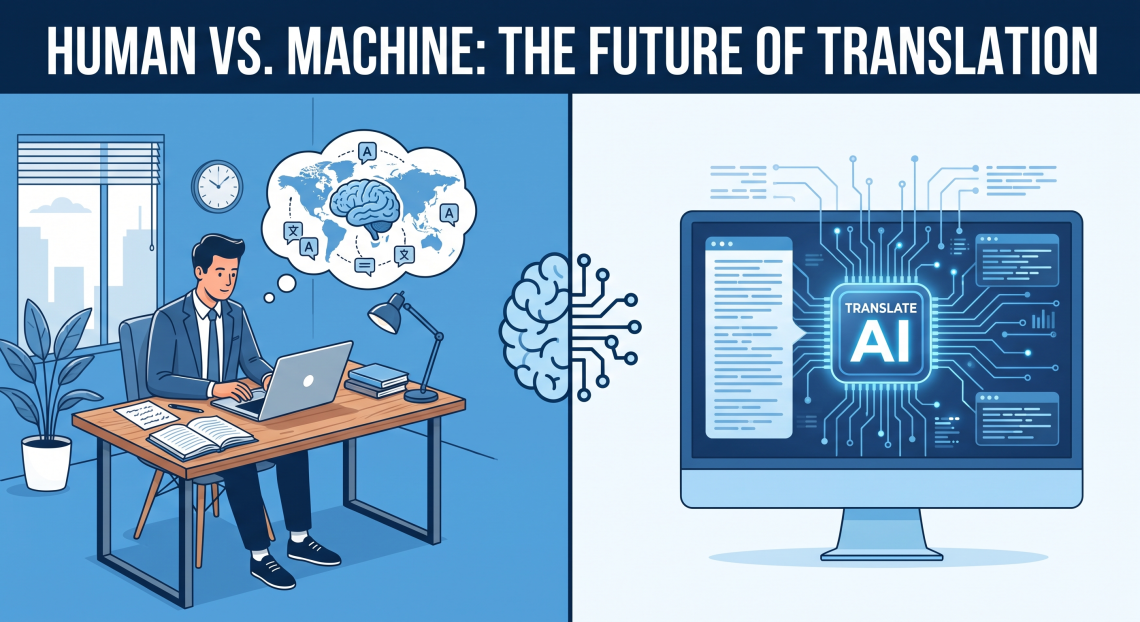
Human translation involves a professional linguist who reads source content in one language and rewrites it naturally and accurately in another. Human translators bring cultural knowledge, contextual understanding, and subject-matter expertise that machines still struggle to replicate.
Strengths of Human Translation
- Nuanced understanding of idioms, humor, and cultural references
- Subject-matter expertise (legal, medical, technical)
- High accuracy for sensitive or high-stakes content
- Creative adaptation for marketing and literary content
Limitations of Human Translation
- Higher cost per word compared to machine translation
- Longer turnaround times, especially for large volumes
- Availability can be limited for rare language pairs
What Is Machine Translation?
Machine translation (MT) uses algorithms—most commonly neural machine translation (NMT)—to automatically convert text from one language to another. Tools like Google Translate, DeepL, and Microsoft Translator have become remarkably capable in recent years, handling everyday communication with impressive fluency.
Strengths of Machine Translation
- Instant results at massive scale
- Very low cost per word (often free)
- Consistent output without fatigue
- Supports hundreds of language pairs
Limitations of Machine Translation
- Errors with idioms, slang, and specialized terminology
- Lacks cultural sensitivity and tonal awareness
- Unreliable for legal, medical, or regulated industries
- Output may feel stilted or unnatural
Human vs. Machine Translation: A Side-by-Side Comparison
| Factor | Human Translation | Machine Translation |
|---|---|---|
| Accuracy | Very high for complex content | High for simple, structured text |
| Speed | Slower (hours to days) | Instant |
| Cost | $0.08–$0.25 per word | Free to very low cost |
| Cultural nuance | Excellent | Limited |
| Best for | Legal, medical, marketing, literary | Internal docs, gisting, high-volume routine text |
| Scalability | Limited by human capacity | Unlimited |
When to Use Human Translation
Certain scenarios demand the expertise and judgment that only a trained human translator can provide.
Legal and Regulatory Documents
Contracts, court documents, patents, and compliance materials require precise, legally binding language. A mistranslation can have serious consequences, including voided agreements or regulatory penalties. Always use a certified human translator for legal content.
Medical and Clinical Content
Patient records, drug information, clinical trial documents, and consent forms deal with life-and-death accuracy. Medical translators are often required to hold relevant credentials and subject-matter expertise.
Marketing and Brand Messaging
Taglines, product descriptions, and ad copy need to resonate emotionally with local audiences. Machine translation can produce technically accurate sentences that completely miss the intended tone or cultural relevance.
Literary and Creative Content
Books, screenplays, and creative writing require a translator who can preserve voice, rhythm, and style—qualities no algorithm can reliably reproduce.
When to Use Machine Translation
Machine translation is not just acceptable but preferred in many situations, particularly where speed and volume matter more than perfection.
Internal Communications
Quick translation of internal memos, chat messages, or operational documents where slight imperfections are acceptable can be handled efficiently by MT tools.
High-Volume, Low-Sensitivity Content
Product catalogs, inventory lists, FAQs, and user-generated content at scale are ideal use cases for MT, especially when human review of every item isn’t feasible.
Getting the Gist
When you simply need to understand what a foreign-language document says—without publishing the output—machine translation is fast and practical.
The Best of Both: Machine Translation Post-Editing (MTPE)
Many organizations today combine both approaches through Machine Translation Post-Editing (MTPE). An MT engine produces a draft, then a human editor reviews and refines the output. This hybrid model can cut costs by 30–50% while maintaining professional quality. It’s ideal for high-volume projects where pure human translation is too slow or expensive.
When MTPE Makes Sense
- E-commerce product pages at scale
- Software localization with thousands of strings
- News articles and time-sensitive content
- Support documentation and knowledge bases
Frequently Asked Questions
Is machine translation accurate enough for professional use?
For general and internal content, modern MT engines like DeepL are often accurate enough. For legal, medical, or marketing content, human review is strongly recommended.
How much does human translation cost?
Rates typically range from $0.08 to $0.25 per word, depending on the language pair, subject matter, and turnaround time. Specialized fields like legal or medical translation cost more.
Can machine translation replace human translators?
Not entirely. MT excels at speed and volume but lacks the cultural judgment and contextual accuracy that human translators provide for complex or sensitive content.
What is neural machine translation (NMT)?
NMT is the current standard for MT engines. It uses deep learning models trained on vast corpora of bilingual text to produce more fluent, contextually aware translations than older rule-based or statistical systems.
Which is better for website translation—human or machine?
It depends on the content. UI strings and product specs can often use MT with light review. Marketing copy, blog posts, and landing pages benefit from human translation or MTPE.
What languages does machine translation handle best?
High-resource language pairs like English–Spanish, English–French, and English–German achieve very high accuracy. Lower-resource pairs (e.g., English–Swahili) still have noticeable quality gaps.
Is MTPE faster than pure human translation?
Yes. Post-editing an MT draft is typically 40–60% faster than translating from scratch, making MTPE a cost-efficient option for large projects.
Conclusion
Neither human nor machine translation is universally superior—the right choice depends on your content type, audience, risk tolerance, and budget. For high-stakes documents, nuanced marketing content, or legally sensitive materials, human translation remains the gold standard. For fast, high-volume, or low-risk content, machine translation delivers unmatched efficiency. When in doubt, consider MTPE as the practical middle ground that gives you both speed and quality.